

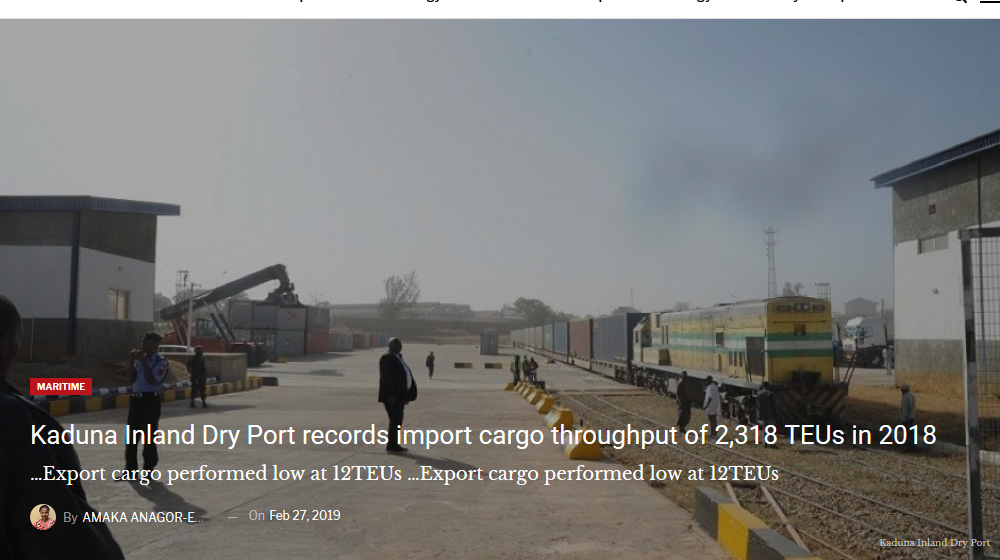
A total of 2,318 twenty-foot equivalent units (TEUs) containers of
import cargoes were handled in the newly commissioned Kaduna Inland Dry
Port (KIDP) between January and December, 2018, Import Performance
Rating obtained exclusively from the Nigerian Shippers Council (NSC),
has revealed.
Furthermore, the dry port handled only about 12 TEUs of export cargoes within the period under review.
The performance rating shows that container traffic was slightly low in the second quarter of the year, due to the Apapa gridlock, operational challenges and insecurity, towards the fourth quarter of the year 2018 in the Kaduna environment.
In the area of import, KIDP recorded monthly average of over 150 containers in throughput, which was described as a positive development, considering that it is a new port.
A breakdown of the import shows that a total of 248 TEUs of containers were handled in January; 226 containers was recorded in February; 289 containers were handled in March; 218 containers in April; 193 containers were handled in May while a total of 195 containers were handled in the month of June.
A total of 161 containers of import cargoes were also handled in the Kaduna port in July; 178 containers in the month of August; 128 containers in the September; 154 containers were received in the port in October; another 154 containers in the November, while the remaining 174 containers were handled in December.
The Import Performance Rating shows that mostly household equipment and vehicles were brought in as import in Kaduna Port.
On
the other hand, the 12 containers of export cargo comprised of ginger
that was taken to Rotterdam and cow-horn as well as charcoal that were
shipped to Vietnam.
“The export performance within the period was
extremely poor. This was due to lack of railway locomotives and wagons,
lack of export product cluster, problems of packaging and operational
challenges.”
Kaduna port, operated by the Inland Containers
Nigeria Limited (ICNL), has the capacity to handle a minimum of 29,000
TEUs of containers annually. The port targets transit cargo for
neigbouring countries of Chad and Niger, whose owners would have
opportunity to clear their cargo in Kaduna without additional cost of
air ticket, accommodation and other issues that involve coming to Lagos.
Commenting, Hassan Bello, executive secretary of the NSC told BusinessDay in an interview that rail is cardinal to the success of dry ports because the main aim of dry ports was to reduce congestion in the seaport.
Bello stated that rail is needed to reduce cost because the cost of transporting cargo from Apapa to Kaduna Port by truck has become astronomical.
“If we have the rail, it will reduce one quarter of the cost and the volume will increase. Rail would ensure seamless connection from the seaport to the inland port. Now, what we have is road transportation of cargo by truck. The Kaduna dry port would have been busier if we had rail transport,” he said.
Bello
disclosed that the Council is currently working with the Nigeria Railway
Corporation (NRC) to provide ten wagons and two locomotives to attend
to the needs of importers and exporters.
“The Federal Government
is giving attention to the workability of the dry port. We have got
Kaduna commissioned and we are working on Funtua and Jos. There is one
coming up in Ibadan and if we complete that, it means transport
efficiency will increase and there will be reduction in the cost of
doing business,” he explained.
Recall that President Muhammadu
Buhari in January 2018, commissioned the Kaduna Port in Kakuri, Kaduna
State. Kaduna Port is the first Inland Dry Port to be completed in
Nigeria, from the seven approved across the country. Others include
Ibadan, Aba, Kano, Jos, Funtua and Maiduguri and they are at various
stages of completion.
The completion of the Kaduna Port was facilitated by the declaration of Kaduna as a port of origin and destination on the 16th of May 2015, by the former President Jonathan administration, meaning that the port is now recognised by the United Nations Conference on Trade and Development (UNCTAD) as a port to which goods can be consigned from, and from where goods can also be consigned to from another destination.
Yusuf Ismail, managing director of the ICNL said recently in Lagos that the inability of the NRC to move cargoes from the Lagos port to the Kaduna port, has affected economic activities at the port.
Ismail said that the high freight cost of containers to the port by road from Lagos is taking toll on the business, which, according to him, has increased by 100 percent, making the port uncompetitive.
The cost of transporting cargo from Lagos to Kaduna port would have been cheaper if the rail line was in perfect condition. But, since the rail is not working, we are forced to be using road and the condition of roads in Nigeria is bad. This has increased cost of transportation such that instead of spending N400,000 for to move one by 40-foot container, we spend N800,000 to move one 40-foot from Lagos to Kaduna,” Ismail said.
AMAKA ANAGOR-EWUZIE
Source:- Businessdayng



Now Playing: Love Bug
Aretti Adi
SPONSORED LINKS
LOAN FOR TRAVEL, VISA, JAPA, PoF UP TO N200M (CLICK HERE)
[CLICK HERE] For Music Artwork, Website Design And SEO Setup
INSTALL 9JAFLAVER MUSIC APP, STREAM, DOWNLOAD, AND PLAY MUSIC OFFLINE
CHECK OUT FUNNY PICTURE AND MEME HERE (CLICK HERE)
Chissom Anthony – Glory To God In The Highest [See Trending Gospel Song]
Copyright © 2014-2026 9jaflaver. All Rights Reserved.
About us | DMCA | Privacy Policy | Contact us
| Advertise| Request For Music | Terms Of Service
9jaflaver is not responsible for the content of external sites.