

Multidimensional Poverty: Akwa Ibom, Rivers lead South-South states with most poor people
In a recent eye-opening report, data technology company StatiSense unveiled distressing findings from the Multidimensional Poverty Index (2022) report of the National Bureau of Statistics (NBS).
The report sheds light on the staggering number of people living in multidimensional poverty in Nigeria’s oil-rich Niger Delta region, comprising states such as Akwa Ibom, Rivers, Cross River, Edo, Delta, and Bayelsa. The figures are nothing short of alarming and raise serious questions about the effective use of resources and policy implementation in these states.
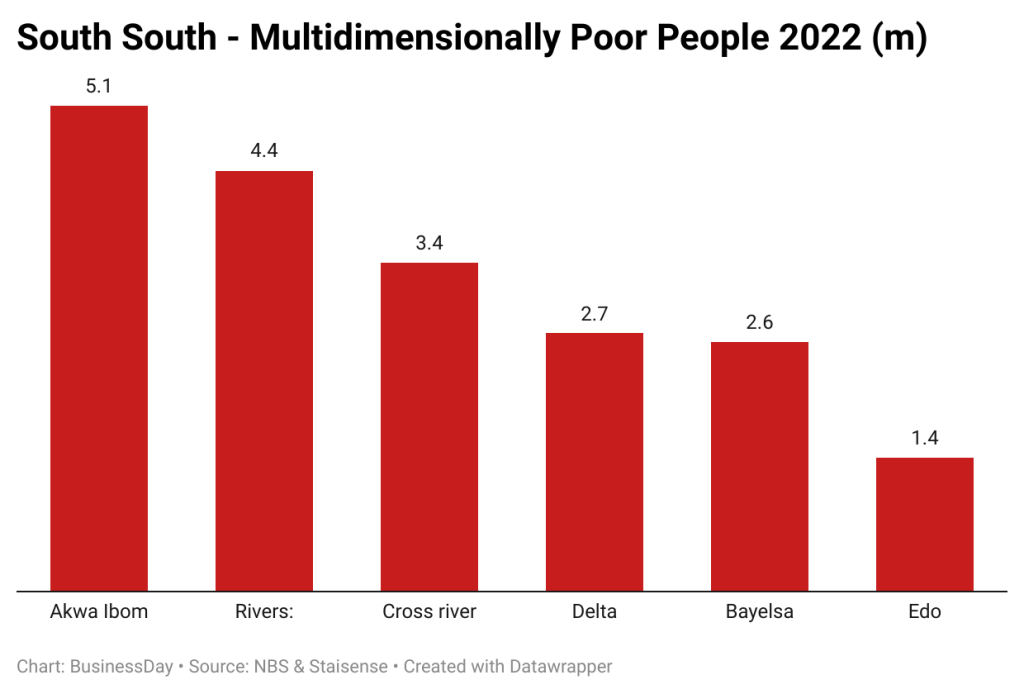
The report reveals that Akwa Ibom, Rivers, and Cross River states are the hardest hit, with 5.08 million, 4.4 million, and 3.44 million people respectively living in multidimensional poverty. For Akwa Ibom state, this represents over 71 percent of its total population of 5.451 million people estimated by the National Population Commission (NPC).
Similarly, in Rivers State, the 4.4 million people living in multidimensional poverty account for 62.4 percent of the state’s estimated 7.47 million inhabitants. Cross River State also struggles significantly, with 3.44 million people living in multidimensional poverty, constituting a staggering 75.6 percent of the state’s population.
While Edo and Delta States also face challenges, their numbers are relatively lower compared to the states mentioned earlier. Edo has 1.4 million people living in multidimensional poverty, representing 35.4 percent of its estimated 3.9 million population, while Delta has 2.73 million people in poverty, which is just under 50 percent of its population.
Bayelsa State emerges as the most concerning case, with a shocking 2.61 million people living in multidimensional poverty, constituting a staggering 88 percent of the state’s estimated 2.9 million inhabitants. The Ijaw ethnic group-dominated state, despite receiving significant funds from the federation account (N87.13 billion in 2021), faces a severe challenge in improving the living standards of its people.
The 13 percent derivation funds, intended to ensure that resource-rich regions benefit from their natural resources, have been a subject of scrutiny.
Many analysts and policymakers question why these funds have failed to uplift the living standards of the people in these states. Despite receiving substantial financial support, poverty persists and worsens with the rising cost of living, magnified by increases in fuel prices and the depreciation of the naira, the national currency against major international currencies especially the US dollars.
Stanley Nwani, lecturer of economics at the Pan Atlantic University, Lagos told BusinessDay in a telephone conversion that the region needs a comprehensive and multi-faceted approach to dealing with the issue of multidimensional poverty.
“There is an urgent need for transparent and accountable governance in the region, with a focus on responsible allocation and use of funds. The government must prioritize investing in infrastructure, education, healthcare, and job creation to lift people out of poverty and ensure sustainable development, a view many people hold.”
“Furthermore, the report underscores the necessity of community-driven development initiatives. By involving local communities in decision-making processes and development projects, the effectiveness and relevance of these efforts can be maximized.
“Sustainable economic diversification is also crucial. Over-reliance on oil revenue leaves states vulnerable to fluctuations in global oil prices. Encouraging investment in other sectors, such as agriculture, manufacturing, and tourism, can create alternative income streams and reduce the impact of oil price volatility.
“Education and skill development play pivotal roles in poverty reduction. By equipping individuals with the necessary tools and knowledge, they can access better job opportunities and improve their economic prospects.
“Finally, it is essential to strengthen social safety nets. Establishing effective welfare programs and support systems can provide a safety net for vulnerable populations, helping them weather economic challenges and improve their well-being,” Nwani said.
In conclusion, the StatiSense report serves as a stark reminder of the deep-rooted multidimensional poverty plaguing Nigeria’s oil-rich Niger Delta region.
The findings call for urgent action from policymakers, stakeholders, and communities to address the systemic issues contributing to poverty. Only through collective efforts and a commitment to sustainable development can these states realize their full potential and provide a brighter future for their citizens.
Source:- Business Day



Now Playing: Love Bug
Aretti Adi
SPONSORED LINKS
LOAN FOR TRAVEL, VISA, JAPA, PoF UP TO N200M (CLICK HERE)
[CLICK HERE] For Music Artwork, Website Design And SEO Setup
INSTALL 9JAFLAVER MUSIC APP, STREAM, DOWNLOAD, AND PLAY MUSIC OFFLINE
CHECK OUT FUNNY PICTURE AND MEME HERE (CLICK HERE)
Chissom Anthony – Glory To God In The Highest [See Trending Gospel Song]
Copyright © 2014-2026 9jaflaver. All Rights Reserved.
About us | DMCA | Privacy Policy | Contact us
| Advertise| Request For Music | Terms Of Service
9jaflaver is not responsible for the content of external sites.