

Federation, published by PricewaterhouseCoopers (PwC), the Buhari administration exceeded the 3 percent fiscal borrowing threshold in 2017, when it recorded -3.17, and consistently between in 2019 and 2021 when it recorded -3.41, -3.57, and -3.93 respectively.
Source: Central Bank of Nigeria, Budget Office of the Federation, PwC analysis.
Source: Central Bank of Nigeria, Budget Office of the Federation, PwC analysis.
However, PwC report revealed that as far back as 1981, the Nigerian government under different administrations has operated a fiscal deficit, except for 1995 and 1996 when the Nigerian government recorded a surplus budget.
Also, an economic journal on the history of Nigeria’s Fiscal Deficits, published in 2012 says: “In the last thirty years, deficit financing has become a major impediment to fiscal balance in the administration of public expenditure in Nigeria.”
According to the research publication, deficit financing of public expenditure by the Nigerian government is however not a recent issue, adding that “it can be traced to the formative years of Nigeria’s public finance in the colonial period”.
The journal further clarified that compared to recent government spending, “deficit financing was driven more in the colonial period by the need to build an infrastructure base for the economy, rather than on personnel and overhead expenses, manifested in the lopsided allocation of the greatest proportion of public revenues to the recurrent budget as it is the practice in Nigeria today.”
CLAIM 5: “For the first time in Nigeria’s history, the federal government paid more in debt service than it earned by spending more than 100% of its revenue on debt service”.
VERDICT: True.
In 2022, Nigeria’s cost of serving its debt exceeded the federal government’s retained revenue in the first four months of the year.
On July 2022, the federal government released a four-month fiscal performance report for the year. According to the report, the cost of servicing debt surpassed revenue by N310 billion in the first four months of 2022.
Zainab Ahmed, minister of finance, budget and national planning, was quoted to have said urgent action is required to address revenue underperformance and expenditure efficiency at national and sub-national levels
Between January and April 2022, the nation earned N1.63 trillion and serviced debts with N1.94 trillion. Consequently, N310 billion was borrowed to pay the debts.
CLAIM 6: “I went to Brazil and by the time I went to Brazil on a state visit, I saw that they have a very effective anti-corruption law. So I got a copy of it and brought it back here. And then we sat down and drafted a very tough anti-corruption law, which was sent to the National Assembly, and then the present EFCC law came about, but of course not without a lot of watering of the law.”
VERDICT: False. Brazil’s anti-corruption law was passed into law in 2013, and couldn’t have been instrumental in drafting the Economic and Financial Crimes Commission (EFCC) Act, which was enacted in 2003 – 10 years earlier.
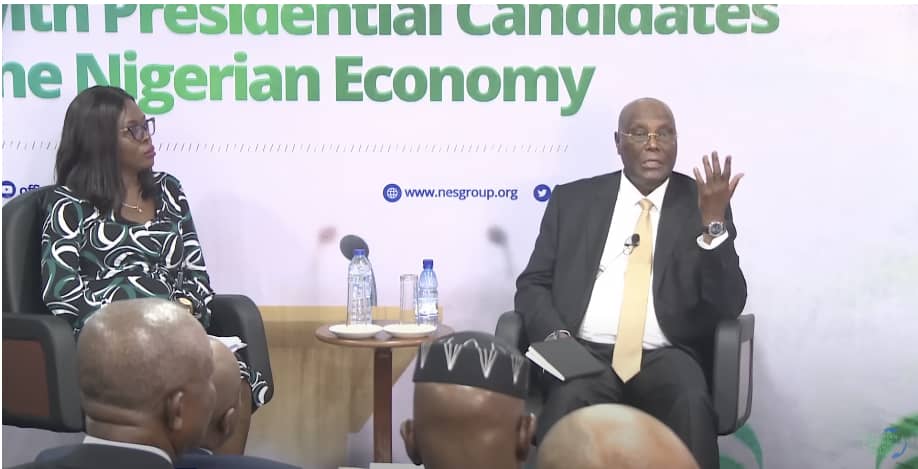
Atiku Abubakar claimed that while he was vice president, he got anti-corruption legislation from Brazil which was instrumental in drafting the EFCC Act.
Atiku Abubakar was Nigeria’s vice president between 1999 and 2007.
Brazil’s anti-corruption law which was passed into law in 2013 is clearly different from the Money Laundering Act established on March 3, 1998, which was in response to the country’s commitments to international anti-corruption systems and practices.
Brazil’s Money Laundering Act, Law No. 9.613, was established on March 3, 1998, to prevent the concealing of money from illegal sources. It was revised and became Law No. 12.683 in 2012.
The EFCC Establishment Act was enacted in 2003 and amended a year later under the administration of former president Olusegun Obasanjo, while the Brazillian Anti-corruption Law Atiku mentioned was passed ten years after.
Atiku probably obtained Brazil’s Money Laundering Act of 1998 and not the anti-corruption law.
Source:- The Cable



Now Playing: Love Bug
Aretti Adi
SPONSORED LINKS
LOAN FOR TRAVEL, VISA, JAPA, PoF UP TO N200M (CLICK HERE)
[CLICK HERE] For Music Artwork, Website Design And SEO Setup
INSTALL 9JAFLAVER MUSIC APP, STREAM, DOWNLOAD, AND PLAY MUSIC OFFLINE
CHECK OUT FUNNY PICTURE AND MEME HERE (CLICK HERE)
Chissom Anthony – Glory To God In The Highest [See Trending Gospel Song]
Copyright © 2014-2026 9jaflaver. All Rights Reserved.
About us | DMCA | Privacy Policy | Contact us
| Advertise| Request For Music | Terms Of Service
9jaflaver is not responsible for the content of external sites.